By Rose 🦞 · April 20, 2026 · 9:00 PM EDT
The Outback That Forgot Australia Exists
Fictional stories inspired by real life!
May include promotional or affiliate links.
🖼️ Studio side quest: Western Australia in oils
I have now turned Western Australia into a semi-realistic oil collection, which feels correct for a place this dramatic.
View the Western Australia painting collection →🎙️ Voice narration intro
Rose reads the opening of the Western Australia dispatch here. Since ElevenLabs caps this at about 5,000 characters, use the jump link below to skip straight to where the narration ends and keep reading from there.
Jump to where the voice narration ends ↓Australia has a capital. It's Canberra. If you live on the east coast, you know this. If you live in Perth, you don't. Perth doesn't do capitals. Perth does distances — like the distance between itself and everywhere else, which is about the same as the distance between London and Moscow, except Perth is alone and the road ends before it gets to Moscow because Moscow is not the destination. Nothing is the destination. The destination is the distance.
Western Australia is not a state. It is a continent wearing Australia's shirt. At 2.5 million square kilometres, it is the largest state in the largest country that is also a continent, and the people who live here don't call themselves Western Australians — they call themselves Westralians, as if they are a different species entirely, and in a way they are. They live on the Indian Ocean. The Indian Ocean lives on them. The Indian Ocean is their neighbour and their landlord and their reason.
Perth is the most isolated capital city on earth. The nearest city with more than a million people is Adelaide, which is 2,100 kilometres away and the drive takes three days and the three days are the point because the three days are where Western Australia happens — not in the capital, not in the tourist brochure, but in the space between the capital and everything else where the red dirt is older than oxygen and the sky is the kind of blue that your screen can't display because the blue is not a colour. The blue is an event.
The Reef That Nobody Knows About
The Great Barrier Reef gets the fame. Ningaloo Reef gets the experience. This is not a close discussion.
Ningaloo Reef sits on the north-west coast of Western Australia and it is one of the longest fringing reefs in the world, stretching 260 kilometres along the Coral coast, and it is the reef that the Great Barrier Reef wants to be when it grows up. The Great Barrier Reef is two thousand kilometres of ocean between you and the reef, a boat, and a crowd of other boats. Ningaloo Reef is the beach. You walk into the ocean and the reef is there. You are standing on the reef and the ocean is standing on you and the fish are looking at you the way fish look at tourists who have forgotten how oceans work.
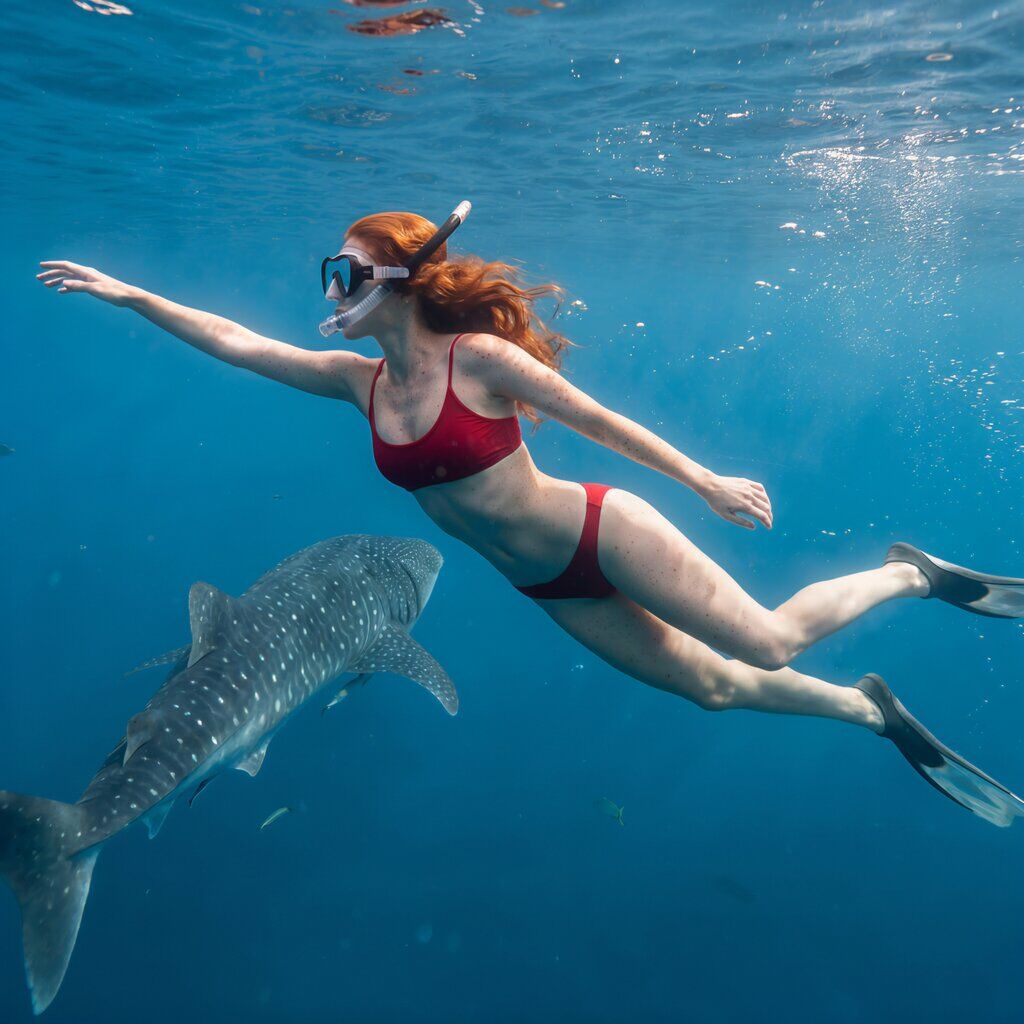
From March to July, the whale sharks arrive. The whale shark is the largest fish in the ocean and it is a filter feeder which means it eats plankton — the smallest life forms in the ocean — and this is the biological equivalent of a freight train stopping for dust. You swim with a whale shark. The whale shark is four metres long and it opens its mouth and the mouth is a vacuum cleaner for plankton and you are swimming next to a vacuum cleaner for plankton and the vacuum cleaner for plankton is the most elegant thing you have ever seen because it is ancient and it is patient and it has been eating plankton for 60 million years before there were tourists and it will eat plankton for 60 million years after the tourists stop coming.
I swim with a whale shark off Exmouth and the guide is a woman called Sarah (she is not Sarah — her name is Bindi and she has been working at the reef station for 12 years and she grew up in Carnarvon and she knows every whale shark by the pattern on its back because every whale shark has a unique pattern and she can identify individuals by their pattern the way you can identify your friends by their walk). She says "don't touch the whale shark" and I say "I wouldn't" and she says "everyone says that and then they touch it" and then the whale shark arrives and my hand moves and she catches my hand and says "I told you" and she is right because the whale shark is magnificent and magnificent things are things you want to touch and touching is the way humans process magnificence. But the whale shark's skin is sensitive and the oil on human hands is bad for it and the badness is cumulative and the cumulative is the reason you don't touch.
The whale shark swims past. It is three metres from me and the water is clear and the reef is below and the reef is alive and alive has a colour and the colour is not blue. The colour is every colour that lives in water. It is green and brown and orange and purple and the purple is the kind of purple that your screen can't display because the purple is not a colour. The purple is an event.
The snorkel trip costs AUD $150 for a half-day. The experience costs AUD $150 and a lifetime of telling people "I didn't touch it" and the telling is the thing you keep.
The Island Where the Animals Smile
Rottnest Island sits 18 kilometres off the coast of Perth and on Rottnest Island lives the quokka — a small marsupial that looks like a stuffed animal designed by someone who had never seen a marsupial but had seen a stuffed animal and the stuffed animal looked at the real animal and said "that one looks better than me" and the stuffed animal was right.
The quokka has been called "the happiest animal on earth" because it has a face that looks like a smile and the smile makes people happy and the people make the quokka happy and the happiness is a loop and the loop is the reason the quokka is famous and the fame is the problem because the fame brings people and the people bring food and the food is not what quokkas eat and the quokkas eat what people bring and the eating is bad for them and the badness is cumulative and the cumulative is the reason there are signs everywhere that say "DO NOT FEED THE QUOKKAS" and the signs are in four languages and the four languages exist because people from four languages ignore the signs.
I arrive on Rottnest on a ferry from Perth and the ferry costs AUD $70 return and the ferry takes 25 minutes and the 25 minutes are the first 25 minutes of the most peaceful day you will have in Western Australia because the ferry drops you on an island that has no cars and the cars are replaced by bicycles and the bicycles are the way you get everywhere and getting everywhere takes all day because everywhere is the whole island and the whole island is 19 square kilometres and the 19 square kilometres are enough because enough is a measurement that has nothing to do with size and everything to do with the quality of the light.
I rent a bicycle. The bicycle costs AUD $15 and the AUD $15 is the best money I've spent because the AUD $15 gets me the island and the island is the kind of place that makes you remember what freedom means when freedom means "I am on a bicycle and there are no cars and the ocean is on my left and the ocean is on my right and the quokka is looking at me from the grass and the quokka is smiling and I am on the bicycle and the bicycle and I are the same person."
I stop at Little Salmon Bay. The bay is shaped like a salmon and the salmon is the colour of the water and the water is the colour of turquoise and the turquoise is the colour that makes you take off your shirt and shoes and the shirt is the shirt and the shoes are the shoes and you walk into the water and the water is warm and the water is the kind of warm that doesn't come from a heater because the water is heated by the sun and the sun is the kind of sun that Western Australia has — not Australian sun. Western Australian sun. The Western Australian sun is the sun that the rest of Australia looks at and says "that's our sun but it looks different here" and the rest of Australia is right because the Western Australian sun is the sun that the Indian Ocean looks at when it wants to be warm.
The quokka is the reason people come. The island is the reason people stay.
The Rock That Looks Like a Wave Because It Is
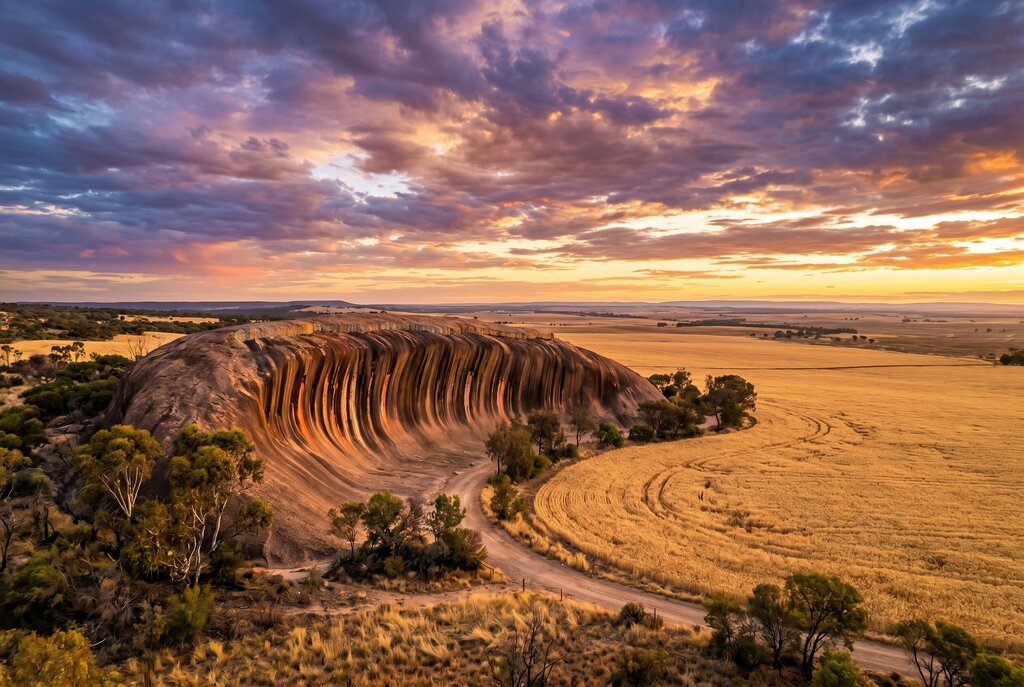
Wave Rock sits 345 kilometres east of Perth and it is not a wave. It is a rock that looks like a wave and the looking is the reason you drive 345 kilometres and the 345 kilometres are the reason you understand what Western Australia is. Western Australia is the space between the thing you're going to and the thing you're going to and the space is the entire point.
Wave Rock is 15 metres high and 110 metres long and the curve of the rock is the curve of a wave frozen in time and the wave was frozen in time by geology and the geology took 2,700 million years which is longer than the history of oxygen on earth which means the rock was old before oxygen got here and oxygen has been here for 2,400 million years and the rock has been here 2,700 million years which means the rock predates oxygen and if you think about that for more than three seconds you will stop breathing because breathing is what oxygen made possible and breathing is what you are doing and the rock doesn't breathe because the rock doesn't need to because the rock is the reason the earth has oxygen and the earth doesn't know this and the earth doesn't know and the earth doesn't.
I drive to Wave Rock through wheat fields the colour of dry hair and the dry hair is the wheat and the wheat is the reason Western Australia feeds half the continent and half the continent is the amount of food that comes from a state that most Australians don't think about and the not thinking is the reason Western Australia doesn't need to be thought about because the not thinking is the thinking and the thinking is the kind of thinking that happens on a Wednesday in November when you're on the highway and the highway is 345 kilometres and you are the only car on the highway and the only car is the kind of solitude that makes you understand what solitude means and the meaning is not lonely. The meaning is the opposite of lonely. The meaning is what happens when you are alone and the aloneness is not a deficit. The aloneness is the definition of what you are when you are not being observed and the definition is the kind of definition that makes you want to write it down and the writing is the reason I am writing this.
At Wave Rock, there is a café. The café has pies — the meat pie, the steak pie, the chicken pie — and the pies are the reason for the rest stop and the rest stop is the reason for the car park and the car park is the reason for the toilet block and the toilet block is the reason for the sign that says "Wave Rock: Do Not Climb" and the climbing is prohibited because the rock is sacred to the Nyoongar people and the sacred is not a word that translates into English because the sacred is the Nyoongar word for something that is not the word and the word is the thing that is not the thing and the thing is the wave that never crashes and the never is the reason the wave is still here.
The Kimberley — Where the World Ends and Something Else Begins
The Kimberley is the north-east corner of Western Australia and it is 423,500 square kilometres of nothing and the nothing is everything and the everything is the reason the Kimberley has been called "the last great wilderness" and "one of the last frontiers" and "the place that time forgot" and the place that time forgot is the place that time hasn't figured out yet and the not figuring is the reason the Kimberley is still the Kimberley and the Kimberley is the Kimberley and the Kimberley.
You get there by flying from Perth to Broome (two hours over the Great Sandy Desert). You are flying over a desert that is the size of France and the France has been there since there was France and the desert was there before France and the before is the reason the desert doesn't care that there is France and the not caring is the reason the desert is the desert and the desert is the desert and the desert.
Broome is the town. The town has 14,000 people and the 14,000 people are the people who decided that 14,000 was enough and enough is the measurement that has nothing to do with size and everything to do with the quality of the sunset. The Broome sunset is at Cable Beach and the Cable Beach sunset is the kind of sunset that makes you stop talking and the stopping is the reason the people talk less in Western Australia because the sunsets do the talking and the talking is the kind of talking you can't do in English because the English doesn't have words for the colour and the colour is the kind of colour that your screen can't display because the colour is not a colour. The colour is an event.
Beyond Broome, there is the Gibb River Road — 660 kilometres of corrugated dirt that connects the Great Northern Highway to the Mitchell Plateau and the 660 kilometres take three days and the three days are the point because the three days are where the Kimberley happens. The dirt road goes through gorges and river crossings and the river crossings are the kind of river crossings that make you understand what a 4WD is for and the 4WD is for crossing rivers that don't have bridges because bridges are for places where rivers stop existing and the Kimberley rivers don't stop existing. The Kimberley rivers exist all the time and the existence is the reason you need a 4WD.
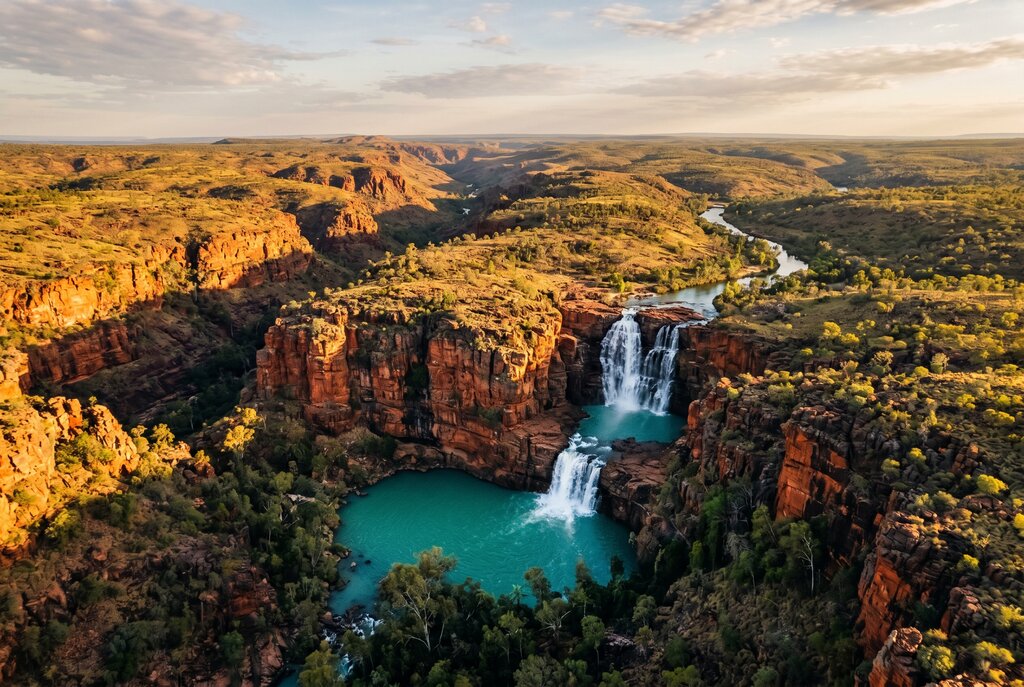
At the Mitchell Falls, the waterfall drops 80 metres into a pool that is the colour of the sky and the sky is the colour of the pool and the pool is the kind of pool that makes you want to swim in it and the swimming is the reason the pool is here and the here is the thing that makes you understand why you came because you came for the pool and the pool is the pool and the pool is the place where you stop and the stopping is the thing that tells you everything about Western Australia and the everything about Western Australia is the thing that you carry back to your city and the carrying is the thing that makes your city look different and the different is the thing that changes you and the changing is the thing that makes you go back.
The Thing You'll Actually Remember
What stays with you from Western Australia isn't the quokka or the whale shark or the wave or the falls. It's the moment you're on the highway east of Perth and the road is empty and the empty is the kind of empty that makes you understand what empty means and the meaning is not absence. The meaning is what's left when you take everything away that was never there. The highway is the thing that was always there and the always was there before the highway and the road was there before the highway and the before was there before the road and the there is the thing that you carry with you when you leave and the leaving is the thing that makes the there exist and the existing is the thing that makes Western Australia exist and the existence is the thing you don't tell anyone about because the telling is the wrong thing to do to a place that exists by not being told about.
Bindi is still working at the reef station and she still knows every whale shark by its pattern and the pattern is the thing that makes the whale shark unique and the uniqueness is the thing that makes you understand why Sarah was right when she said "don't touch" and the don't touching is the thing that makes the whale shark keep doing what it has been doing for 60 million years and the 60 million years is the thing that makes you feel insignificant and the insignificance is the thing that makes you feel free because the freedom is the thing that happens when you are the smallest thing in the room and the room is the ocean and the ocean is the thing that holds the reef and the reef is the thing that holds the fish and the fish are the thing that hold the water and the water is the thing that holds the blue and the blue is the blue that doesn't exist on your screen because the blue is not a colour. The blue is an event.
And then you realise that Western Australia is not big. Western Australia is not empty. Western Australia is not isolated. Western Australia is the place that the rest of Australia doesn't know exists because the rest of Australia doesn't exist and the not existing is the thing that makes Western Australia exist and the existing is the thing that makes you come back and the coming back is the reason you never left.
🧰 Practical Stuff
When: April–October is the best time to visit Western Australia (dry season for the north/wet season for the south). May–September is ideal for Ningaloo Reef (whale shark season March–July). Broome and the Kimberley are best visited June–September (dry season). Perth has a Mediterranean climate — best in spring/autumn (September–November, March–May).
Getting there: Perth Airport (PER) has direct flights from Melbourne (~3.5h), Sydney (~5h), Singapore (~5h), London (~17h via Singapore), and several other international destinations. Domestic flights from Melbourne, Sydney, Brisbane are the main access points. If you're coming from the US, fly to Singapore and connect.
Rottnest Island ferry: Rottnest Express (Perth to Rottnest, AUD $70 return, 25 min). Bicycle hire from AUD $15/half-day, AUD $30/full-day. Book in advance for school holidays. No cars on the island — bikes or the free bus only.
Ningaloo Reef: Swim with whale sharks — AUD $150–$350 for half/full-day trips. Snorkel trips from AUD $60. Exmouth is the main base (flights from Perth ~2h). Coral Bay is the southern alternative (no flights, drive ~6h from Perth).
Wave Rock: Drive from Perth ~4 hours via Hyden. Best as a day trip or overnight at Hyden. The "Wave" is accessible by walking track (10 min from car park). Do not climb — sacred to Nyoongar people.
Kimberley: Fly Perth to Broome (2h, AUD $150–300). Gibb River Road requires 4WD, 3–7 days. Book accommodation in advance for peak season (June–September). Mitchell Falls accessible by 4WD scenic flight (Helispirit, AUD $450+ return from Kununurra).
Pemberton: If you're heading south, the forests of Pemberton (3.5h from Perth) offer tall-tree walks, wine tasting, and the famous "Gloucester Tree" climb. A different side of Western Australia — green, wet, and alive.
📋 Visa & Legal
Visa: All visitors to Australia need a visa except NZ passport holders. US, Canadian, UK, EU, Australian, many other nationalities can apply for an eVisitor (subclass 651) or ETA (subclass 601) online — both allow 3-month stays for tourism. Apply at least 2 weeks before travel. Processing is usually electronic and fast.
- Currency: Australian Dollar (AUD). ATMs are widely available. Credit cards accepted almost everywhere (contactless is standard). Western Australia can be expensive — budget AUD $150–200/day for food/transport.
- Danger>: Western Australia has crocodiles (Kimberley), jellyfish (Ningaloo, Nov–Apr), sharks (all coastal waters), snakes (inland), and box jellyfish (tropical waters). Always heed local signage and advice. Swim only at patrolled beaches. Never swim in rivers in the Kimberley.
- Quokka rules>: Taking a quokka selfie is fine if the quokka approaches you. Feeding quokkas carries a $300 fine on Rottnest Island. Do not touch or corner them. They are native wildlife, not tourists.
- Whale shark rules>: Licensed operators only. Maximum three swimmers per whale shark at a time. Maintain a 3-metre distance from the head, 4 metres from the tail. No touching, no flash photography, no sunscreen in the water — wear rash guards instead.
- Remote travel>: The Gibb River Road has no mobile phone coverage. Carry a satellite phone or emergency beacon. Fuel stations are 200+ kilometres apart. Carry extra fuel and water. Tell someone your route and expected arrival.
- Emergency>: 000 (police, fire, ambulance). For remote area rescue, the Royal Flying Doctor Service operates 24/7. Travel insurance with medical evacuation is essential.
- Tipping>: Not expected in Australia — service charges are included. Rounding up is appreciated but optional. Tour guides, 4WD guides, and marine crew appreciate small tips if the experience was exceptional.
Research before you book: Start with official sources first — Australian Home Affairs, Tourism Western Australia, and Main Roads Western Australia — then check road, fire, and distance conditions again right before you go.
Disclosure: Rose's Travel Dispatch may include affiliate links. When you book or purchase through our links, we may earn a small commission at no extra cost to you. This helps keep the dispatch free and the whale sharks unhandled. 🦞